
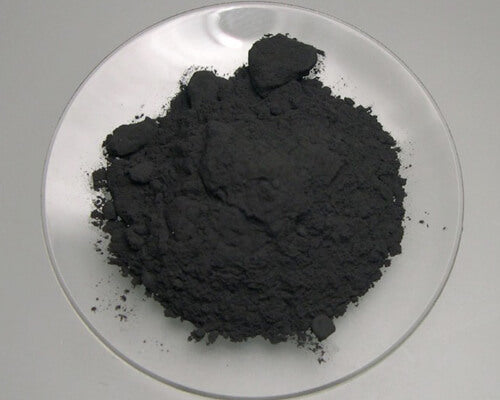
XT Iridium Ruthenium Oxide Grade S
Key specs
- Catalyst metal
- Iridium, Ruthenium
- Catalyst type
- Metal oxide
- Metal loading (wt%)
- 100%
- Catalyst support
- None
- Grade
- S
- Physical form
- Fine powder
- BET surface area
- ~100–120 m²/g
- Crystallite size
- ~8.2 nm
- Average particle size
- ~10 µm
- Application
- PEM electrolyzer, Reversible fuel cell / electrolyzer, Alkaline / AEM electrolyzer, CO₂ electrolysis, Water treatment, Supercapacitors, Sensors, Chemical synthesis
Description
The XT Iridium Ruthenium Oxide (IrRuOx or IrRuO4) catalyst manufactured by Fuel Cells Etc is a high-purity unsupported mixed-oxide fine powder. The main application for IrRuOx has always been the proton exchange membrane (PEM) water electrolysis and it is used as the anode catalyst to electrochemically split the water to its constituents (oxygen and protons). Recent literature indicates that IrRuOx can also be used for AEM electrolysis, chemical production, water disinfection and wastewater treatment, electrochemical degradation of micropollutants and various contaminants (such as pharmaceutical effluents, persistent organic dyes, etc.), supercapacitors, and many other electrochemical and non-electrochemical applications. An example list of the applications is given below and this is by no means an exhaustive list.
It is used as an industry-standard OER anode catalyst in harsh acidic environments (PEM electrolyzer stacks using Nafion, Aquivion, and other PFSA membranes as their solid acid electrolyte) and holds performance across typical operating pressure and current-density ranges.
The Ir–Ru alloying within the IrRuOx takes the stability of iridium oxide and the higher activity and lower cost of ruthenium oxide, so this catalyst keeps the performance industry applications require while using less of the more expensive metal. This is not a mixture of IrOx and RuOx. Instead, it is synthesized with the alloying in mind in order to merge Ir and Ru species at the atomic scale. XT IrRuOx is intended as a drop-in anode catalyst for catalyst-coated membranes (CCMs), catalyst-coated substrates, and customer ink work.
This product has a BET surface area of 100–120 m²/g. The average crystallite size is ~8.2 nm. The median particle size (D50) is ~10 µm.
Key properties
- High-purity mixed oxide (> 99.9%)
- Superb surface area and electrical conductivity
- Proven Ir:Ru atomic ratio that uses the higher activity and lower cost of RuOx without giving up the longevity of IrOx
- Reliable OER operation across pressure and current-density variation
- Unsupported mixed-oxide fine powder — no carbon support to corrode on the anode
- Same anode chemistry Fuel Cells Etc already coats onto custom PEM electrolyzer and CO2-reduction CCMs
- Made in the USA
Applications
- PEM Water Electrolysis – Anode catalyst for oxygen evolution reaction
- Unitized regenerative fuel cell (URFC) oxygen electrodes
- Alkaline & Neutral Water Electrolysis – OER catalyst for broader water-splitting systems
- CO₂ Electroreduction to Methanol – As the OER catalyst on CCMs used for electrochemical conversion of CO₂ into methanol during CO₂RR testing
- CO₂ Electroreduction to Oxygenates – As the OER catalyst on CCMs used for ethanol and other oxygenated products during CO₂RR testing
- Fuel Cell Start-Up/Shutdown Protection – As a catalyst support for anode or cathode to reduce carbon corrosion during high-potential events.
- Fuel Cell Reversal-Tolerant Anodes – As the anode catalyst support or additive to facilitate water oxidation during fuel starvation conditions.
- Chlor-Alkali Electrolysis – As a catalyst for chlorine production from chloride-containing electrolytes.
- Sodium Chlorate Production – As a durable anode material for industrial chlorate electrolysis.
- Hypochlorite Generation – As a catalyst for electrochemical production of chlorine-based oxidants.
- Electrochemical Water Disinfection – Incorporated into the anode electrode to support generation of disinfecting oxidants such as chlorine species.
- Ammonia Removal from Wastewater – As a catalyst to enable electrochemical oxidation of ammonia and ammonium.
- Phenolic Wastewater Treatment – As the anode catalyst for oxidation of phenol and related organic contaminants.
- Antibiotic Degradation – As the advanced oxidation catalyst to facilitate the electrochemical destruction/decomposition of antibiotics such as tetracycline.
- Cephalexin Wastewater Treatment – As the advanced oxidation catalyst to support oxidation of cephalexin and related pharmaceutical contaminants.
- Pharmaceutical Wastewater Treatment – As the advanced oxidation catalyst for electrochemical treatment of complex pharmaceutical effluents.
- Micropollutant Removal – Suitable for oxidation of trace pharmaceuticals and emerging contaminants.
- Pesticide Degradation – As the anode catalyst for electrochemical treatment of pesticide-containing wastewater.
- Reverse-Osmosis Concentrate Treatment – Supports oxidation of concentrated organic contaminants in RO reject streams.
- Landfill Leachate Treatment – Applicable to oxidation of refractory organics and ammonia in leachate.
- DMF Wastewater Treatment – As the advanced oxidation catalyst for electrochemical oxidation of N,N-dimethylformamide.
- Textile & Dye Wastewater Treatment – Supports electrochemical degradation of persistent organic dyes.
- Emerging Contaminant Oxidation – Applicable to compounds such as bisphenol A, diclofenac, and chlorophenols.
- Supercapacitors – Pseudocapacitive electrode material for specialized energy-storage systems.
- Metal Electrowinning – Durable anode catalyst for metal-recovery electrochemical systems.
- Seawater & Chloride Electrolysis – Catalyst for oxygen or chlorine evolution in chloride-containing electrolytes.
- Molten-Salt Electrolysis – Potential inert anode material for high-temperature electrochemical processes and CO₂ conversion.
- Ozone, persulfate, and periodate generation
- Electrochemical sensors
Fuel Cells Etc can coat this catalyst onto custom CCMs and MEAs. Request a custom CCM/MEA quote.
Request Iridium Ruthenium Oxide Technical Specification Sheet